
Continue with your email address to access your account.
A few details are enough to manage your reservations faster.
Enter the 6-digit code sent to your email address.
Enter your email address and we will send a reset code.
Enter the code sent to your email and your new password.
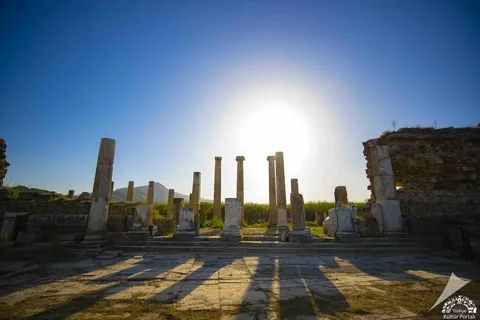
The ancient city of Magnesia is located within the borders of Tekin Village, connected to the Ortaklar area of Germencik district in Aydın Province, on the Ortaklar–Söke highway. According to legend, the city was founded by the Magnetes who came from Thessaly. The location of the first Magnesia, established in Anatolia following the prophecy and guidance of Apollo, is unknown. According to Diodorus, due to epidemics caused by the frequent flooding and changing course of the Menderes River, as well as the Persian threat, the Athenian Thibron relocated the city in 400–399 BC. Most likely, rather than founding a new city, Thibron brought the inhabitants of Magnesia to the slopes of Thorax (Gümüş) Mountain, to a place called Leukophrys, and protected them there. For this reason, it is more accurate to consider present-day Magnesia as having been established in a later period. The new Magnesia was a walled city covering an area of approximately 1300x1100 m², featuring a grid-planned street system. It held an important commercial and strategic position between Priene, Ephesus, and Tralleis. Magnesia’s reputation today largely stems from the architect Hermogenes, whose designs and implementations have survived to the present. According to the ancient writer Vitruvius, Hermogenes was the first architect to define the pseudodipteros temple plan and classify temple types according to column spacing. Vitruvius also states that Hermogenes’ masterpiece is the Temple of Leukophryne in Magnesia. Hermogenes built this temple during the Hellenistic period on the ruins of an earlier archaic temple. The temple, in Ionic order with 8x5 columns and dimensions of 67.5x40 meters, is the fourth largest temple of the Hellenistic period in Anatolia.
Excavations carried out between 1994 and 2001 in the Artemis sanctuary revealed a marble-paved ceremonial area between the temple altar and the agora. The ceremonial area is surrounded by reliefs of gods reaching up to 3 meters in size, with sacrificial rings placed in front. Inscriptions known as “Topos,” indicating the designated standing areas for groups participating in ceremonies, are found on the paving blocks that define the sides of the area. Sections of the stoa surrounding the sanctuary have also been uncovered. Another important structure of Magnesia is its agora, which has largely disappeared under silt today. Entry to the agora was through a sacred gate from the Artemis sanctuary. The propylon has been completely uncovered. With an area of 26,000 m² and 414 columns, the agora was among the largest marketplaces of its time. A structure previously thought to belong to the Byzantine period was later identified through excavations between 1989 and 2001 as a Roman-period “Market Basilica,” decorated with reliefs depicting the story of the dog-legged Skylla known from Homer’s “Odyssey.”
Magnesia Ancient City is one of the most impressive yet relatively lesser-known archaeological sites in Aydın. Its location among major ancient cities such as Priene, Ephesus, and Tralleis makes it historically and strategically significant.
Especially the structures bearing the traces of architect Hermogenes offer a unique experience for those interested in ancient architecture. With its organized city planning, wide streets, and sacred areas, Magnesia presents visitors with the orderly and aesthetic world of the past.
The most important structure of the city, the Temple of Artemis, is considered the masterpiece of Hermogenes. This magnificent Ionic structure is one of the largest temples of the Hellenistic period and is architecturally very impressive.
The marble-paved ceremonial area located between the temple and the agora was an important space where religious rituals were held. The reliefs of gods and inscriptions provide valuable insights into the belief system of the time.
Although largely lost today, the Agora of Magnesia was one of the largest commercial centers of the ancient world. With an area of 26,000 m² and hundreds of columns, it was an impressive structure.
The Propylon, which provided access to the Artemis sanctuary, is one of the rare structures that has been fully uncovered. This gate symbolizes the grandeur of entering the sacred area.
This Roman-period structure stands out with its reliefs depicting mythological scenes. Especially the depictions of Skylla increase its artistic value.
The world-famous Ephesus is one of the most important stops to complement your visit to Magnesia.
Known for its grid-planned urban design, Priene reflects a similar planning approach to Magnesia.
Located in the center of Aydın, this ancient city is an ideal destination to explore the region’s historical richness.
During your visit to Magnesia, you can experience the rich cuisine of Aydın and its surroundings. Especially:
These flavors reflect the gastronomic identity of the region.
Spring and autumn months are the most suitable periods to visit the Ancient City of Magnesia. During these seasons, weather conditions are more favorable and the travel experience is much more enjoyable.
Magnesia Ancient City, with its magnificent past, architectural innovations, and historical depth, is a special destination that deserves to be discovered. Away from crowded tourist routes, it is an ideal stop for those seeking a more peaceful and authentic experience.
If you want to explore a different historical route in the Aegean Region, be sure to add Magnesia to your list and experience this impressive ancient city on site.
Contact our team to get detailed information about this record.