
Continue with your email address to access your account.
A few details are enough to manage your reservations faster.
Enter the 6-digit code sent to your email address.
Enter your email address and we will send a reset code.
Enter the code sent to your email and your new password.
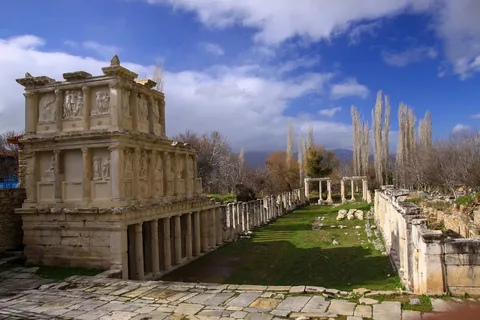
The Ancient City of Aphrodisias is a unique archaeological site located near Geyre Village in the Karacasu district of Aydın and is considered one of the most important settlements of the ancient Caria region. This fascinating city, which can be explored within Didim attractions and Historical tours in Didim, is famous for being dedicated to Aphrodite, the goddess of love and beauty, and stands out with its magnificent structures that have survived to the present day.
Aphrodisias, which can be visited through Didim daily tours, Tours from Didim and Daily excursions from Didim options, offers a unique experience for culture and history enthusiasts.
The settlement history of Aphrodisias dates back to the 5th millennium BC, around 5000 BC. Important findings from the Chalcolithic Age have been discovered from this period. In the 6th century BC, the settlement appeared as a small village, and the first Temple of Aphrodite was built during this time.
The city became a true polis in the 2nd century BC during the Hellenistic period and was reorganized with a grid-based city plan. During the Roman period, especially from the 1st century BC onward, it experienced significant development and gained privileges such as tax exemption under the protection of Emperor Augustus.
During this time, thanks to the rich marble quarries in the region, Aphrodisias became an important center of sculpture and gained great fame in art, architecture, and religion. It remained one of the most important cities of the Caria region until the 3rd century AD, but lost its importance due to earthquakes and changing conditions in the 6th and 7th centuries and was completely abandoned in the 12th century.
The city takes its name directly from Aphrodite and has a special cult center dedicated to her as the protective goddess. The Temple of Aphrodite and her statue gained great fame in the ancient world.
This temple, the heart of the city, was built in the Hellenistic period and later converted into a church during the Byzantine era. The remaining columns and foundations still reflect its former grandeur.
With a length of 270 meters and a capacity of approximately 30,000 people, this structure is one of the best-preserved stadiums of the ancient world.
The theatre, with a capacity of around 7,000 people, is made of white marble and stands out with its aesthetic architecture.
This monumental gateway consisting of four-sided columns is one of the most impressive restored structures of Aphrodisias.
Agoras, baths, the bouleuterion (council building), and the Sebasteion (a structure dedicated to the imperial cult) reflect the rich architectural heritage of the city.
The Aphrodisias Museum, located at the entrance of the archaeological site, was opened in 1979. Sculptures, reliefs, sarcophagi, and other archaeological artifacts uncovered during excavations are exhibited here.
Especially the works belonging to the Aphrodisias sculpture school form the most striking part of the museum. The integration of the museum with the archaeological site provides a great advantage for visitors.
Aphrodisias was included in the UNESCO World Heritage List in 2017. The ancient city and the surrounding marble quarries are preserved together. Its architectural, artistic, religious, and cultural importance, along with its well-preserved structures, played a key role in its inclusion on this list.
The archaeological site and museum are open to visitors 7 days a week. During the summer period, it generally operates between 08:00 - 19:00, while in the winter period closing hours are earlier.
The Museum Card is valid. Since the area is quite large, it is recommended to wear comfortable walking shoes. Excavation works are still ongoing, and new findings are occasionally displayed.
Aphrodisias is not just an ancient city; it is one of the finest examples of art, architecture, and the cult of Aphrodite. As a must-see destination within Cultural tours in Didim and Best guided tours in Didim, it offers visitors the grandeur of the ancient world.
This ancient city, which should definitely be included in your Didim activities and Things to do in Didim list, can be easily visited through Private tours in Didim and Day trips from Didim options. It is also an important cultural route that can be included in Altinkum daily tours and Akbük daily tours programs.
It is especially recommended to visit Aphrodisias during spring and autumn for a more enjoyable experience in terms of weather and crowd levels. Discover this unique historical heritage and embark on an unforgettable journey.
Contact our team to get detailed information about this record.