
Continue with your email address to access your account.
A few details are enough to manage your reservations faster.
Enter the 6-digit code sent to your email address.
Enter your email address and we will send a reset code.
Enter the code sent to your email and your new password.
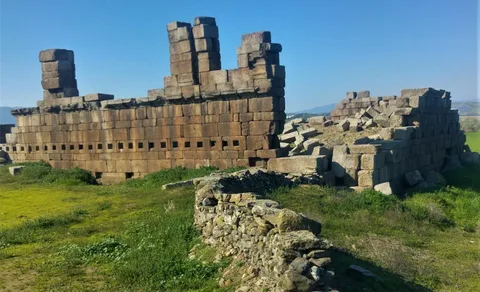
Alabanda (Araphisar)The ancient city of Alabanda is located within the borders of Doğanyurt village in the Çine district of Aydın Province. Araphisar, where the ancient city of Alabanda is situated, is a neighborhood of Doğanyurt village. The city spreads on the slope of two hills, extensions of Karadağ, 4 km west of the Çine Stream (Marsyas), extending northward toward the Çine Plain. The road to Alabanda is asphalt and passes through the middle of the ancient city, reaching Alinda.The name Alabanda is derived from the Carian words Ala (horse) and banda (race). The Byzantine historian Stephanos states that the city was named Alabanda after Alabandos, the son of King Kar, who won a horse race. Cicero, on the other hand, says in his work “De Natura Deorum” that the city took its name from the Carian god Alabandos. Later, although it is not mentioned during Alexander the Great’s arrival in Anatolia, the first information about Alabanda dates back to the end of the 3rd century BC. Accordingly, the Seleucid king gave the city the name Khrysor Antiokhia. An inscription found in Delphi states that, upon the request of Antiochus III, the Amphictyonic Council declared the inviolability of Alabanda, and accordingly, the city was dedicated to Zeus Khrysaoeos and Apollo Isotimos.
The city of Alabanda was destroyed by the Macedonian King Philip V (221–179 BC) before the Battle of Magnesia in 190 BC. After this war, with the Peace of Apamea in 188 BC, Alabanda shared the same fate as Lycia and Caria under the rule of Rhodes and Antiochus III. However, Rhodes could not establish strong control over the city and only maintained a priest of Helios. During the Mylasa–Rhodes war in 167 BC, Alabanda acted as a free city and fought alongside Mylasa against Rhodes. The Roman historian Livy mentions that in 170 BC, the people of Alabanda sent envoys to Rome with a golden crown weighing 23 kg and many gifts. Coin minting in Alabanda began in the 3rd century BC shortly before it became Antiokheia Khrysaoreus. Although minting was interrupted at times, it continued during the Roman Imperial period. The coins feature depictions of the winged horse (Pegasos), likely related to the city’s founding myth.
After Rome fully dominated Anatolia in 70 BC, Alabanda became the 21st city of Asia under Antiochus III. When Ephesus was declared the provincial capital by Mark Antony in 48 BC, it became a regional center, and Miletus, Priene, Tralleis, and Nysa were connected to it.
Alabanda maintained good relations with Rome in the 1st and 2nd centuries BC. In AD 22, Tiberius granted the city the right of asylum (asylia) again. Strabo notes that the city was very wealthy, its people were fond of entertainment, and many girls in the city played the harp.
In the 4th century AD, Alabanda came under Byzantine rule and later became a bishopric center connected to the metropolis of Aphrodisias. In the 11th century, the city, under Turkish rule, changed hands again during the Crusades. However, it has been under Turkish control since 1280. Excavations in Alabanda were first carried out in 1905–1906 by Ethem Hamdi Bey. Since 1999, excavations have been conducted under the leadership of the Aydın Museum Directorate with the permission of the Ministry of Culture and Tourism and the General Directorate of Cultural Heritage and Museums to bring the ancient city of Alabanda into the world of archaeology and tourism.
Alabanda Ancient City is one of the most remarkable settlements of the Carian civilization and offers a unique discovery point for both history and nature enthusiasts. With its dominant position over the Çine Plain, impressive past, and mythological stories, it provides visitors with an experience beyond an ordinary ancient city visit.
Especially its Pegasos-figured coins, deep-rooted history, and strong relations with Rome are among the features that distinguish Alabanda from other ancient cities in the region.
One of the most striking structures of Alabanda, the ancient theatre, is built on a natural slope and offers a wide view. The seating rows and structural remains are still observable today.
The Agora was the heart of the city’s social and commercial life. Although its remains are limited today, this area is important for understanding the city’s economic power.
The temple areas dedicated to Zeus Khrysaoeos and Apollo Isotimos reflect the religious structure of the city.
The burial areas spread around the city indicate Alabanda’s large and wealthy population. Different types of tombs can be observed in these areas.
Located very close to Alabanda, Alinda must be seen with its well-preserved structures.
This ancient city, included in the UNESCO World Heritage List, is known as a center of sculpture.
For those who want to experience local life, the surrounding villages offer a sincere and natural atmosphere.
During your visit to Alabanda, you can taste the flavors of Aydın and the Çine region:
Spring and autumn are the most suitable periods to visit the Ancient City of Alabanda. As temperatures can be high in summer, morning hours are recommended.
Alabanda Ancient City, with its historical depth, mythological origins, and natural location, is a special destination waiting to be discovered. Away from crowded tourist routes, it is an ideal stop for travelers seeking a more authentic experience.
Be sure to add Alabanda to your travel plans to discover this hidden historical treasure of the Aegean.
Contact our team to get detailed information about this record.